
Doroteia Flor — “A Navalha”
Co-protagonist from Book II
Mato Branco · Livro IIFaísca’s ally and a strategist with decisions and ambitions of her own. Information, negotiation and logistics make her a decisive force in the band’s life.
In an arid land where debt outlives the men who owe it, an honest craftsman's public hanging breaks his son's faith entirely: Virgílio seals his own body in a shamanic rite that turns flesh into armor, becomes the outlaw the land itself starts hiding, and turns a private debt of blood into an operatic war against the State. Mato Branco is built as a family saga, not a single man's revenge — the debt Virgílio collects is one his own bloodline will keep paying, long after his war is over. Book I is designed to close a complete, satisfying revenge arc on its own terms while opening a story engineered to run for generations.
This is not "an outlaw legend plus fantasy" — the canon underneath it is a family's multi-generational reckoning with debt, land, and inherited violence, where every act of vengeance changes hands rather than ending anything. The "closed body" that makes Virgílio bulletproof is not a superpower without a price: it is a documented physical cost — chronic pain, lost sleep, a body that stops healing like a human one — paid for power borrowed from the land itself. That cost is the actual engine of the story, and the strong iconography riding on top of it (a blind, milky eye; forged brass dark glasses; twin bone-and-horn-handled blades; a band that perfumes itself with stolen French perfume before every massacre) is distinctive enough on its own to carry cosplay, collectibles, and instant on-screen recognition.
Interior Brazil, a mystic backlands frontier ("Mato Branco") under the rule of land barons, in a folkloric-historical register anchored to real 1890s-1960s political texture. Faith, folk magic (jurema rites, "closed body" invulnerability) and frontier lawlessness collide with the hard economics of land, leather, and iron.
Development profiles; visual appearances are under review in the author’s workspace.
Visual development of the work. Open cards to explore; artwork may evolve during production.
Co-protagonist from Book II
Mato Branco · Livro IIFaísca’s ally and a strategist with decisions and ambitions of her own. Information, negotiation and logistics make her a decisive force in the band’s life.
Patriarch and protagonist of the origins
Mato Branco · -2An artisan and Virgílio’s father, he links the origin volumes to the main arc through land, work and the value of a promise. His choices call for a reading beyond the legend inherited by the family.
The institution’s armed agent
Mato Branco · IThe commander of the Baron’s paid militia embodies brutality protected by bureaucratic order. His actions connect Virgílio’s intimate conflict to the local power structure.
Landed power
Mato Branco · IA landowner who combines land seizures, influence and armed force. His rule turns violence into an extension of business and official paperwork.
Patriarch and protagonist of the origins
Mato Branco · IAn artisan and Virgílio’s father, he links the origin volumes to the main arc through land, work and the value of a promise. His choices call for a reading beyond the legend inherited by the family.
Antagonist of Books II–III
Mato Branco · IIA mercenary tracker raises the pursuit to a level that threatens Faísca’s protection. His presence turns the hunt into a struggle between matter, belief and survival.
Protagonist of the urban cycle
Mato Branco · IVHe enters the capital to learn how power works from within. Between policing, favours and money, he tests the distance between confronting an institution and coveting its privileges.
Patriarch and protagonist of the origins
Mato Branco · 0An artisan and Virgílio’s father, he links the origin volumes to the main arc through land, work and the value of a promise. His choices call for a reading beyond the legend inherited by the family.
Protagonist of the urban cycle
Mato Branco · VHe enters the capital to learn how power works from within. Between policing, favours and money, he tests the distance between confronting an institution and coveting its privileges.
Protagonist of the urban cycle
Mato Branco · VIHe enters the capital to learn how power works from within. Between policing, favours and money, he tests the distance between confronting an institution and coveting its privileges.
Patriarch and protagonist of the origins
Mato Branco · -1An artisan and Virgílio’s father, he links the origin volumes to the main arc through land, work and the value of a promise. His choices call for a reading beyond the legend inherited by the family.
Protagonist of the opening arc
Mato Branco · Livro I — O Batismo de FerroAn iron and leather artisan driven toward vengeance after his father’s execution. Ritual invulnerability offers protection, but exacts a physical and human price that no feat can erase.
Visual development of the work. Open cards to explore; artwork may evolve during production.
Nine volumes in discovery order: Books 1–6 first, followed by the origin volumes −2, −1 and 0. Book I — O Batismo de Ferro / The Baptism of Iron — opens a larger family story while delivering its own dramatic arc. The manuscripts are at different stages of development. Primary medium: literary prose; adaptations are possibilities for discussion.
Each work has a development dossier. Ask for the one that interests you and it comes with a first conversation.
This is an IP development portfolio for publishers, producers and partners. Ask for a work's dossier and current stage to explore a partnership.
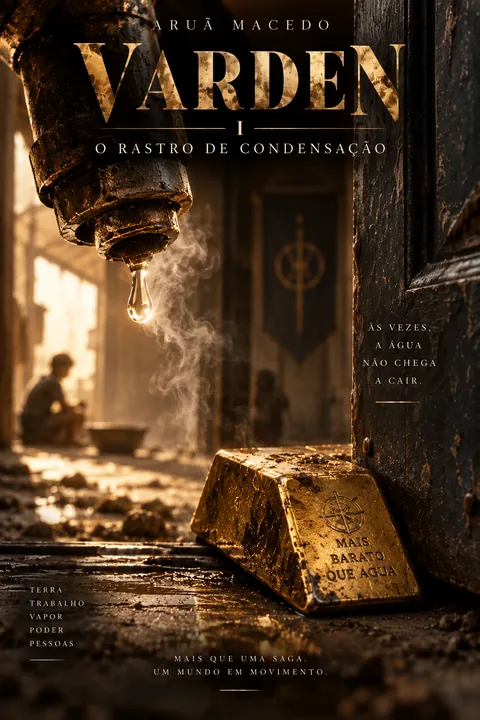 Next workThe Varden Saga